

Greater Cincinnati has a large and growing logistics industry. Warehouses and distribution centers run along I-75 from Dayton through Northern Kentucky, and CVG is a major part of that. According to the airport, CVG is home to Amazon’s primary U.S. Air Hub and DHL’s Global Super Hub for the Americas, and it was the sixth largest cargo airport in North America in 2023.
With that much inventory moving through the region, warehouse security is something property managers and operations managers need to plan for. The Bureau of Labor Statistics notes that warehousing businesses are responsible for both storing goods and keeping them secure.
In most warehouses, the biggest security risks show up in the same few places: shift changes, the loading dock, and after hours. Below, we cover what those risks look like and how security officers help manage them.
Cargo Theft Is Increasing
The FBI groups cargo theft into several categories. Straight cargo theft is the physical theft of goods. Strategic cargo theft involves deception, such as posing as a legitimate carrier to pick up a load. Pilferage involves altering paperwork and taking part of a shipment.
Strategic theft has become a bigger concern. In June 2026, the FBI’s Philadelphia field office issued a warning to the transportation and logistics industry about a significant increase in cargo theft nationwide, including a sharp rise in cyber-enabled strategic theft during 2025.
Many of these schemes rely on a driver showing up at a dock with paperwork that looks legitimate. Having someone at the site who verifies that information before a load leaves is one of the most practical ways to prevent this type of theft.
Shift Changes
During a shift change, a large number of employees may be entering and leaving the building at the same time. Supervisors are usually focused on handoffs and staffing, and the parking lot and entrances are busy.
This is when tailgating is most common, where one person badges in and others follow. Side doors may also be propped open and left that way. It becomes easier for someone who should not be on site to enter without being noticed.
A security officer stationed at the main entrance during shift change helps keep access orderly. Employees are more likely to badge in individually, and the officer can stop anyone they do not recognize. After the shift change, the officer can check secondary doors to make sure they are closed and secured.
This only works if the officer is paying attention to the post. We covered this in more detail in Distracted Guards = Weak Security.
Loading Dock Security
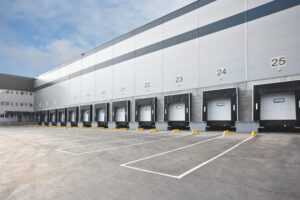
Loading docks often have less oversight than a building’s main entrance, even though that is where inventory leaves the facility.
Dock security should include a verification process. Before a trailer is released, the driver’s name, carrier, truck and trailer numbers, and appointment should be checked against what the shipping office expects. If the information does not match, the load should be held until it is confirmed. Seal numbers should be recorded for incoming and outgoing trailers, and each check should be logged.
This process helps prevent fraudulent pickups, which depend on no one questioning the driver or paperwork. Officers need clear procedures and the authority to hold a truck when something does not match.
Loading docks also see regular traffic from vendors, contractors, and temporary staff. Everyone should be checked in and out using the same process.
Access Control
Access control systems like badge readers, cameras, and gates are important, but they need to be enforced consistently.
Warehouses often have high turnover and seasonal hiring, and many rely on staffing agencies. Badges can be shared, lost, or left active after someone no longer works there. Over time, more people may have access to the building than should.
The Cybersecurity and Infrastructure Security Agency (CISA) defines an insider as anyone who has been given a badge or access device, including employees, contractors, vendors, custodians, and repair workers. CISA also notes that insider threats are not always intentional and can come from carelessness or complacency. CISA’s insider threat mitigation resources are a helpful reference for operations managers developing site policies.
Security officers support access control by keeping visitor logs, keeping restricted areas restricted, and reporting badge or access issues so they can be addressed.
After-Hours Security
After the last shift leaves, there are fewer people on site. Parking lots are darker, and trailers may be parked in the yard overnight. This is when break-ins, trailer theft, and internal theft are more likely to occur.
After-hours officers patrol the perimeter, fence line, trailer yard, and exterior doors. They also monitor cameras, respond to alarms, and confirm that doors locked earlier in the day are still secure. Varying patrol times makes it harder for anyone watching the site to predict when an officer will come by.
Consistent coverage is also important. If an officer calls off and the post goes unfilled, the site is left unprotected. NSG uses site-trained flex officers who already know the building and its procedures, so posts stay covered when schedules change.
Fire Watch for Warehouses
Warehouses rely on sprinkler and fire alarm systems, especially facilities with high racking and large amounts of packaging material.
These systems sometimes go offline. A sprinkler system may be shut down for repairs or construction, pipes can freeze in winter, and power outages or equipment failures can take fire alarm panels offline. When this happens, local fire officials enforcing the Ohio Fire Code may require a fire watch until the system is working again. Northern Kentucky facilities have similar requirements under Kentucky’s fire code.
A fire watch officer patrols the affected areas, looks for signs of fire or other hazards, keeps a log of each patrol, and contacts the fire department if needed. The log is important if there is an inspection, incident, or insurance claim.
NSG provides fire watch services for warehouses and other commercial facilities throughout the region, including on short notice.
Reporting and Documentation
Security reports are useful after an incident, such as missing inventory, an injury, or an insurance claim. Clear, timely reports give operations managers the information they need for investigations and audits.
Reports can also show trends over time, such as repeated alarms at the same door or recurring access issues. We discuss this further in How AI Is Improving Security Reporting and Using Security Data to Strengthen Accountability.
Questions to Ask a Warehouse Security Provider
When comparing security providers for a warehouse or distribution center, it helps to ask:
What happens if an officer calls off? Can you provide fire watch on short notice? Can I see sample reports? How often does a manager visit the site?
For more on this, see What Property Managers Should Expect From a Security Company. If you currently manage security with your own staff, Is It Time to Rethink In-House Security? may also be helpful.
Warehouse Security From NSG

NSG has provided security guard services in Greater Cincinnati, Northern Kentucky, and Dayton since 1988, including for industrial and distribution facilities.
Our officers focus on security while our operations managers handle administrative tasks. Operations managers visit each client site weekly to review performance and address any issues. Our officers are trained on each site, and our flex teams help keep posts covered. Clients can reach us 24/7 and have direct access to senior leadership, and we use KPI tracking to measure performance and spot any issues early. We also provide fire watch when a fire protection system is out of service.
Contact NSG
If your warehouse or distribution center needs security or fire watch coverage, contact NSG to discuss a plan for your facility.